



Championing specialist support for regional Queensland and beyond
Championing specialist support for regional Queensland and beyond
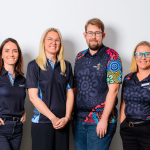
Meet Matt Tribodo, Employment Services Leader – Central Queensland at CoAct Connect + MS Queensland. Matt was named winner of the Leadership Excellence Award at CoAct’s 2026 ConnectUp Awards.
We sat down with him to find out more about why the boy from Bundy is so passionate about his work and giving back to his community.

What does your role as Employment Services Leader look like day-to-day?
I oversee four sites at the moment. I’m based in Bundaberg and look after Bundaberg, Gladstone, Sunshine Coast and Hervey Bay.
Day to day, it’s about running those sites well. There’s a lot of focus on data and making sure we’re on track with performance and delivering the great service we’re known for. But it’s also about supporting the team and helping them achieve their goals.
What’s your “why” for working in employment services, and what’s kept you committed to the work?
I’ve been in employment services and training for about eight years now. I’ve been with MS Queensland for around three years.
Like most people working in this space, I enjoy helping people and seeing them grow and prosper. That’s what got me into employment services. MS Queensland is also just a fantastic organisation to be part of.
I was lucky to lead the Disability Employment Services (DES) program for CoAct Connect and MS Queensland, where we supported people with MS and other neurological conditions, mainly around keeping their jobs. That work was close to my heart and really meant a lot to me. It got me up every day, and seeing what the team was doing made it even more rewarding.
You’re based in Bundaberg and lead the central Queensland teams – what do you love most about regional Queensland and the communities you work with?
I’m a Bundy boy, I grew up here. It used to be a quiet town, and while it’s expanding now, that strong sense of community is still there.
You see it with the other regions, too – up through Gladstone, Pialba and Hervey Bay. People look out for each other. During the recent floods in Bundaberg, everyone pitched in and helped out. They always have. It’s a very tight-knit community.
The weather doesn’t hurt either. We’ve got some of the best weather in the world up here. But for me, it’s about giving back and helping people in the community I grew up in.
MS Queensland is a specialist provider delivering Inclusive Employment Australia with CoAct for people with Multiple Sclerosis and other acquired neurological conditions. Why do you think having specialist providers in this space is so important?
It’s very important, especially in the MS and neurological space. MS Queensland has been around for more than 65 years as a not-for-profit charitable organisation, so we’re very embedded in the MS community.
We also have strong wraparound support services here at MS Queensland. We specialise in this space, so we understand the barriers people face.
If you’re supporting someone with a specific disability, you need that specialist knowledge. You need to understand their barriers and then work out how to help them either stay in their job or find suitable ongoing employment.
That’s a big part of what we do.
You played a big part in the design of CoAct’s MS Specialist service delivery model for Inclusive Employment Australia – what do you think makes it so unique? What challenges does our MS Specialist service aim to solve?
One of the biggest challenges was that the MS model in DES was mainly built around the Work Assist program, helping people stay in their current jobs.
Moving into employment assistance for jobseekers was a shift. We had to work out how to take that model and apply it to helping people find work as well.
Expansion was another challenge. When we delivered DES, we were a small employment service area in South Brisbane with about 180 clients. Now, through Inclusive Employment Australia, we’re across 12 regions in Queensland. So we had to think about how we roll that out and make it work statewide.
Our number one goal is still to help people retain their employment or find meaningful ongoing employment. But there’s more to it than just that.
Sometimes it’s about helping someone who hasn’t left the house for two weeks find a reason to get up each day and have a purpose.
So for us, it’s important we go deeper than just their challenges with work. We also focus on whether the person is getting the social connection they want and need. With MS, people can lose that sense of community after diagnosis. We look at their wellbeing first and make sure they have the support and community connection they need.
We’re backed by our specialist wraparound services, like our allied health team. They’re not just physios or exercise physiologists, they’re neuro-specialised practitioners. We also have NDIS support coordinators on the ground. That whole-of-person approach to supports is what makes our work successful.
What are you most excited about on the horizon for CoAct Connect + MS Queensland?
For me, it’s the growth. We’ve only just scratched the surface in the Inclusive Employment Australia space.
We’ve already expanded into 12 ESAs, and there’s a lot more we can do. I’m excited to see where we can take it, both in employment services and across MS Queensland more broadly.
We’ve always been well known in the south-east, but now we’re building our presence across Queensland. It’s exciting to see how far we can reach and how many more people we can support.
Thanks again to Matt for taking the time to chat with us and being such a valued collaborator in the CoAct network.
If you’re looking for personalised support on your journey into work, education or training, CoAct can help. We have teams across Australia who take the time to understand your story and work with you to develop a plan that’s right for you. Contact us to find out more.
Post categories
- Employers (58)
- Job seeker tips (262)
- NDIS Support Coordination (36)
- News (95)
- Psychosocial Recovery Coaching (5)
- Real stories (207)
- Recovery Coaches (3)
- Referral partners (1)
- Support Coordination Team (6)
Recent posts
Free NDIS information sessions in Ipswich and Logan

What is recovery coaching?


